Delivery Technologies | PQNS, QuanticSphere & VetraSphere | Integria Care
Integria delivery science
Delivery technology, engineered around the active.
We bring delivery science to human and animal health formulations — selecting the technology around the active, the biological environment and the way it will be used.
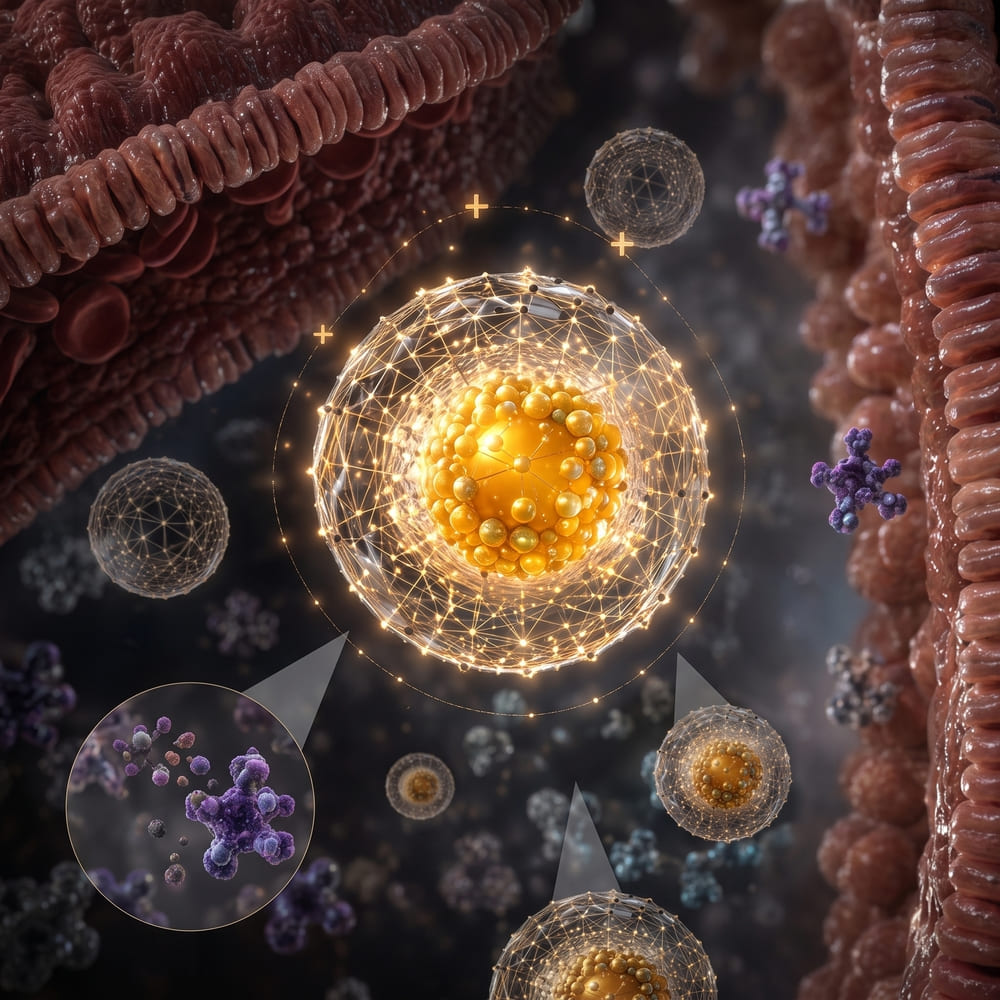
Conceptual platform illustration from the Integria technology deck.
The architecture
One delivery science. Two application platforms.
QuanticSphere™ and VetraSphere™ connect a modular technology library to different formulation needs. The platform defines the application context; the selected technology supports the active’s delivery requirements.
Human Health
QuanticSphere™
Absorption and performance for human health.
Engineered to support active delivery and formulation performance across human health applications—with systems adapted to the ingredient, intended use and product format.
Active protectionFor sensitive ingredients in demanding formulations.
Delivery by designThrough selected carrier characteristics and release profiles.
Targeted formulation needsAcross single actives, formulated blends and topical systems.
Flexible ingredient systemsFor nutraceutical and cosmeceutical development, tailored to the product.
Engineered to support ingredient stability and consistent delivery across animal nutrition systems—with formulations adapted to the species, application environment and delivery format.
Choose a technology to see how it works, what it carries and where its design is focused.
PQNS · Technology overview
A phospholipid approach to active delivery.
PQNS associates bioactives with a phospholipid-based vesicular system, placing compatible ingredients within the lipid structure or its aqueous core. The design focuses on improving dispersion, protecting sensitive ingredients and tailoring release for the intended formulation. Carrier composition, surface charge and particle characteristics are selected around the active, with performance evaluated for each finished system.
MIBS uses a biopolymer matrix to chelate mineral ions and organize them into a dispersed delivery system. The approach is designed to maintain mineral availability while limiting unwanted interactions with other formulation components and dietary binding agents. The choice of mineral, binding strength and release behavior guides development for feed, drinking-water or supplement applications.
The botanical delivery approach combines plant-derived phospholipids and emulsifiers to associate phytochemicals with a nanoscale carrier. Depending on the ingredient, the active can be incorporated within the lipid structure or the aqueous compartment. Development focuses on aqueous dispersion, protection from degradation and controlled release for botanical extracts, polyphenols and essential-oil constituents.
The immune-delivery concept combines polyethylenimine-functionalized carbon quantum dots with silk fibroin nanoparticles. The carbon-based component is designed to associate with antigens and support delivery to antigen-presenting cells, while the silk component provides a matrix for slower antigen release. This is a vaccine-development approach, with immune response, administration route and safety evaluated for the specific antigen and formulation.
CQNS uses functionalized carbon quantum dots as carriers for compatible bioactive compounds, including essential-oil constituents and other poorly dispersible ingredients. Surface chemistry is tailored to associate with the payload and influence aqueous dispersion and release. Development considers both the carrier and its cargo, with biological activity, tolerability and suitability assessed for the intended application.
Technology selection and performance depend on the active, formulation and intended use.
Inside PQNS
A delivery system built around the active.
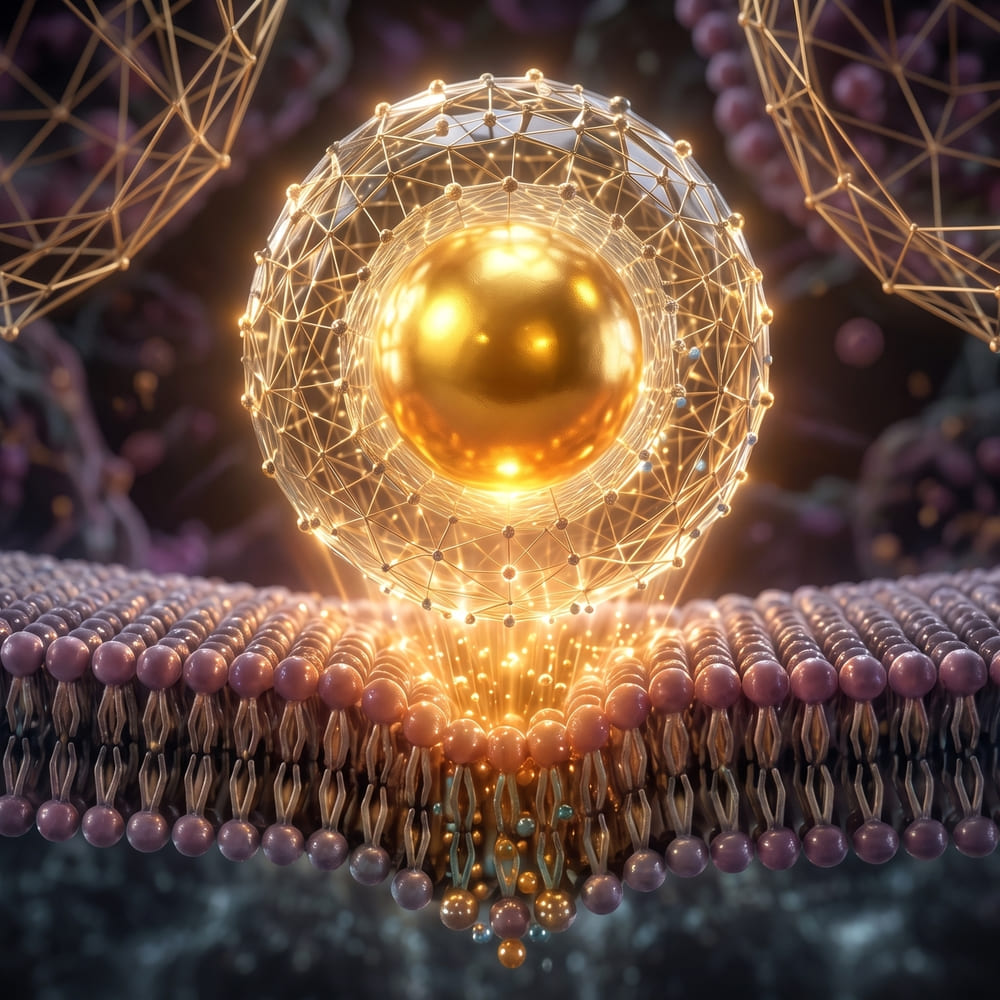
Conceptual illustration, not microscopy or a structural measurement.
PQNS combines bioactives with a phospholipid-based vesicular structure. Its lipid layers, aqueous compartments and surface characteristics are selected around the ingredient—bringing protection, dispersion and release design into one formulation approach.
Explore the architecture
01
Structure with a purpose.
Phospholipids form the vesicular framework around and alongside the active. Their composition and organization are selected to support dispersion and help protect sensitive ingredients in the intended formulation.
02
Different actives. Complementary spaces.
The lipid structure and aqueous compartments offer different environments for compatible ingredients. This provides a basis for incorporating lipid-soluble and water-soluble actives, including selected combinations, within one formulation.
03
The interface matters.
Surface composition and charge influence how the dispersed system interacts with its surroundings. These characteristics are selected and measured under defined conditions; their effect on biological uptake requires formulation-specific evaluation.
04
Release shaped by formulation.
Lipid composition, layer organization and active association provide variables for release design. Testing establishes whether a proposed system delivers the rapid, sustained or staged release profile required for its application.
Engineering priorities
Availability
Release control
Stability
Dose efficiency
Batch consistency
The PQNS delivery journey
Follow the active. Explore the delivery.
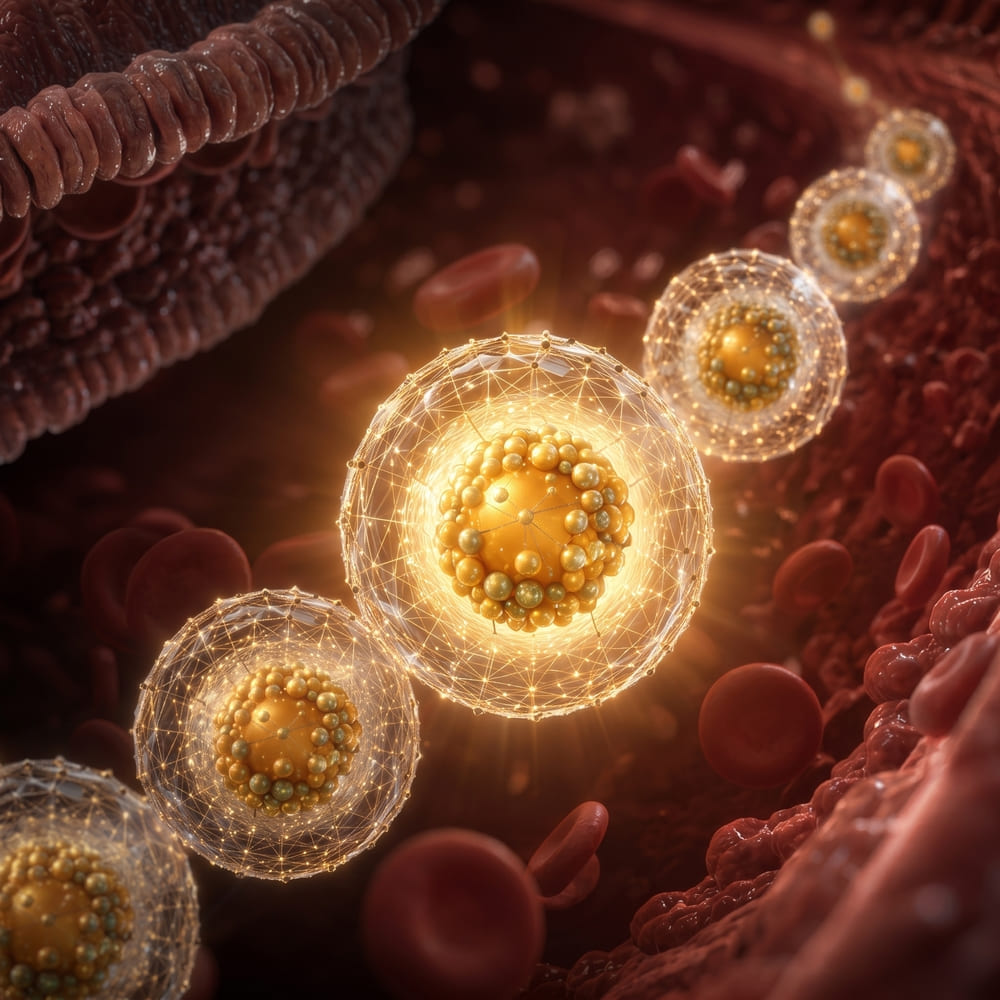
From protection to release, explore the design concept behind oral PQNS delivery.
01
Protection
A phospholipid carrier designed to help protect sensitive ingredients.
02
Transit
Formulation behavior is evaluated under relevant digestive conditions.
03
Membrane interaction
Surface characteristics guide the proposed interaction with membranes.
04
Active release
Composition and active association shape the release profile.
+ Positive carrier surface · − Illustrative membrane charge. Conceptual illustrations, not microscopy; charge, uptake and release require formulation-specific evaluation.
PQNS in motion
Explore the delivery concept.
A one-minute conceptual animation illustrates the PQNS delivery approach using a mitochondrial-support ingredient combination.
Supplied conceptual animation. Illustrations are not microscopy or measurements of clinical performance.
Technology in practice · Laboratory characterization
A closer look at Q-RESVERA™
Trans-Resveratrol
Explore the laboratory characterization of Q-RESVERA™, a Trans-Resveratrol formulation using PQNS delivery technology. Each technique examines a different aspect of the formulated material.
184.4 nmReported DLS Z-average
+64.0 mVReported mean zeta potential
Values are specific to the supplied sample reports and measurement conditions; they are not specifications for every PQNS formulation.
Click to inspect the original figure at a larger size.
DLS · Q-RESVERA™
Particle size in dispersion
The supplied instrument report records a 184.4 nm Z-average for the supplied Q-RESVERA™ Trans-Resveratrol–PQNS sample.
Reported PI: 0.557. This value should accompany the size result; the sample should not be described as narrowly uniform.
HORIBA SZ-100 · 25°C · 90° scattering angle
Click to inspect the original figure at a larger size.
Zeta · Q-RESVERA™
Measured surface charge
The supplied report records a mean zeta potential of +64.0 mV, indicating positive surface character under the reported conditions.
Surface charge alone does not establish shelf life, biological uptake or safety.
HORIBA SZ-100 · 25°C · conductivity 21.124 mS/cm
Click to inspect the original figure at a larger size.
FTIR · Q-RESVERA™
Molecular association
The document interprets the supplied FTIR trace as consistent with the coexistence of resveratrol, phospholipid and cationic components.
Spectral interpretation benefits from the underlying method and reference spectra. It is not a measurement of absorption.
FTIR trace supplied in the resveratrol characterization document
Click to inspect the original figure at a larger size.
Raman · Q-RESVERA™
Characteristic molecular signals
The document identifies characteristic resveratrol signals, including a band near 1608 cm⁻¹, in the supplied Raman trace.
The reported interpretation is consistent with retention of characteristic molecular signals following formulation.
Raman trace supplied in the resveratrol characterization document
Click to inspect the original figure at a larger size.
SEM · Q-RESVERA™
A closer look at morphology
The supplied micrograph shows particulate structures and aggregation in the imaged sample. The original 5 µm scale bar is retained.
This image provides morphology context. It is not a direct measurement of the hydrodynamic diameter reported by DLS.
SEM image supplied in the resveratrol characterization document
Click to inspect the original figure at a larger size.
XRD · Q-RESVERA™
Crystalline features
The supplied XRD trace shows the diffraction features reported for the formulation.
A matched pure-resveratrol trace and the underlying analysis are needed before quantifying a reduction in crystallinity.
XRD trace supplied in the resveratrol characterization document
Formulation development
Defined requirements. Relevant measurements.
The development plan connects your product goals with the tests needed to evaluate a proposed formulation.
01 · Brief
Define the application
Identify the active, intended use, delivery route and processing constraints.
02 · Design
Select the approach
Review the carrier, composition and supply format against your formulation needs.
03 · Evaluate
Test what matters
Assess relevant characteristics, release or stability. Biological studies answer separate performance questions.
04 · Next steps
Plan implementation
Discuss specifications, technical transfer and the information required for scale-up.
Your next formulation
Tell us the active. Let’s explore the delivery.
Share your formulation requirements and the challenge you need to solve.